
Every distributor, contractor, or hospitality buyer who has managed a large tile order knows the real risk isn’t in the catalogue photo — it’s in what happens after the deposit is paid. Shipments arrive later than promised.
A second batch doesn’t match the shade of the first. A supplier who was responsive during negotiation goes quiet once production starts. These are supply chain problems, and most of them trace back to one decision: which manufacturer got picked in the first place.
A reliable tile supply chain isn’t something a buyer inherits by luck. It’s built by weighing a handful of concrete factors before the first purchase order is signed — production scale, quality control discipline, product range, customization ability, and logistics support.
Below is a practical look at what to check, based on what we at JLA Ceramics focus on when working with partners across different markets.
Production Capacity Tells You What a Factory Can Actually Deliver
A catalogue full of attractive designs means little if the factory behind it struggles to maintain output during peak season. Before committing to a supplier, it helps to ask about monthly production volume, how many production lines run at once, and whether floor tiles and wall tiles come from separate facilities or a shared line.
Location matters as well. A factory based near a major port shortens the distance between the production line and the container yard, which can shave days off lead times and lower inland transport costs.
Buyers sourcing from Foshan, a long-established ceramic tile production hub in southern China, often benefit from that kind of proximity to the Guangzhou and Shenzhen shipping routes.
What Sets a Dependable Ceramic Tile Manufacturer Apart From the Rest
Not every factory that produces tiles works to the same level of consistency. A dependable ceramic tile manufacturer typically runs batch-level checks for flatness, color consistency, and surface durability before goods are packed.
It’s worth asking a potential supplier how quality control is structured, and whether test data is shared with buyers on request.
Product range is another signal worth reading into. A manufacturer that produces just one tile format may struggle to support a buyer whose projects call for variety — subway tiles for a bathroom renovation one month, porcelain floor tiles or mosaic accents the next.
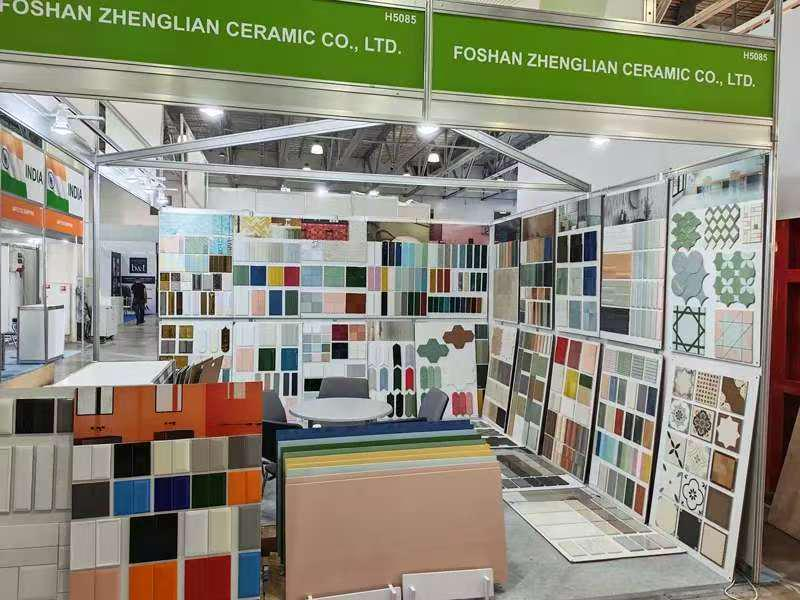
A broader catalogue spanning wall tiles, floor tiles, hexagon and pattern designs, wood-look finishes, and mosaic in ceramic, glass, or porcelain suggests a factory built for ongoing project support rather than one-off orders.
Customization, OEM and ODM Support
Private-label buyers and distributors usually need more than a standard catalogue. Custom sizes, colors, finishes, and packaging under a buyer’s own branding are common requests, and a manufacturer offering ODM or distributor arrangements should be able to negotiate minimum order quantities, pricing, and delivery lead times based on project scope rather than a fixed template.
New product development support matters here too — a factory willing to develop a design specifically for a buyer’s market tends to make a better long-term partner than one offering only existing stock patterns.
Communication Shapes the Relationship as Much as Production Does
Specifications change mid-project. Shipping schedules slip. Container availability shifts without much warning. None of that is unusual in international sourcing, but how a manufacturer responds to it says a lot about the partnership ahead.
A supplier that confirms lead times clearly, flags delays early, and answers questions about MOQ, payment terms, or new product development without long back-and-forth tends to make ongoing sourcing far less stressful than one that only communicates well during the sales stage.
Logistics and After-Sales Support Complete the Picture
Even with strong production and quality control in place, a supply chain can still fall apart at the shipping stage. Flexibility across road, ocean, and air freight options lets a buyer balance cost against delivery speed depending on project urgency.
It also helps to confirm whether technical support stays available after tiles arrive on-site, since installation issues are usually easier to resolve with a supplier that remains engaged past the point of shipment — particularly for larger commercial or hospitality orders where multiple pallets need to match across a single job site.
About JLA Ceramics
Foshan JLA Ceramics has close to ten years of production experience across two dedicated factories, with a combined monthly capacity of around 1,000,000 square meters for floor tiles and 200,000 square meters for wall tiles.
Roughly 80% of that output ships to overseas markets, covering subway tiles, porcelain floor tiles, mosaic, hexagon, pattern, and wood-look designs, along with tile accessories, sanitary ware, and faucets.
Based in Foshan near the Guangzhou and Shenzhen ports, the company supports OEM and ODM partnerships with custom sizing, colors, and finishes, backed by warranty coverage and after-sales technical guidance.
Buyers weighing a longer-term tile sourcing partner are welcome to reach out for a quote or product catalogue to see how the fit works for a specific project.

